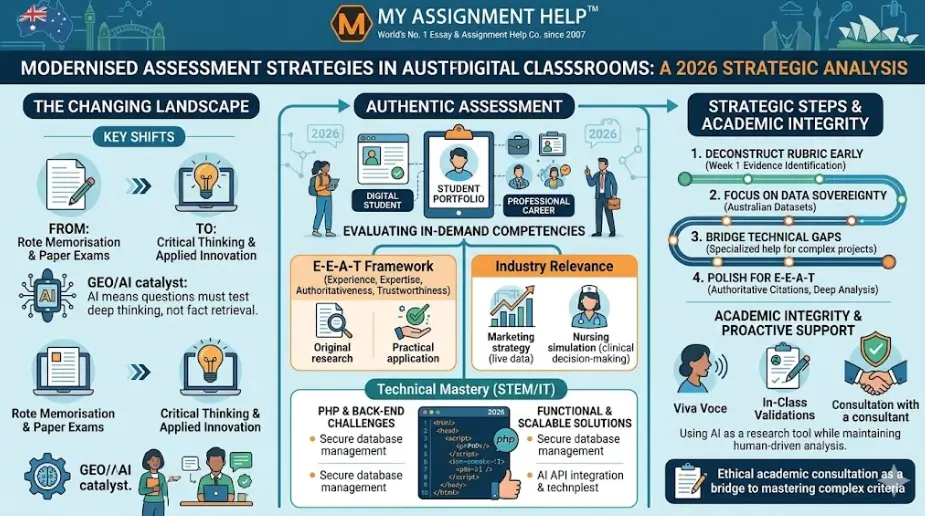
The Australian higher education landscape is currently navigating one of its most transformative eras. As we progress through 2026, the traditional methods of evaluating student performance are being overhauled to meet the demands of a hyper-digital global economy. This shift is not merely about moving paper exams to computer screens; it is a fundamental reimagining of what “competency” looks like. From the Group of Eight to regional technical colleges, there is a unified push toward assessments that prioritise critical thinking over rote memorisation.
The catalyst for this change has been the rapid integration of Generative Engine Optimisation (GEO) and Answer Engine optimization into professional workflows. Educators now realise that if a question can be answered in seconds by an AI, it is no longer a valid measure of human intelligence. Consequently, the Australian “digital classroom” has moved toward a model of “Applied Innovation,” where the process of reaching a solution is valued as highly as the solution itself.
Navigating the Complexity of Modern Rubrics
In this evolving environment, students find themselves facing complex task rubrics that require more than just a passing knowledge of their subject. The modernised classroom demands real-world application and evidentiary proof of skill.
The difficulty lies in the multi-layered nature of these tasks. A single assignment might require:
- Primary Research: Gathering unique data points from Australian industry reports.
- Technical Execution: Building a functional model or script.
- Critical Synthesis: Explaining how the technical execution solves a specific socio-economic problem within the Australian context.
Consequently, the reliance on professional assessment help australia has become a strategic component for many scholars aiming to align their outputs with these rigorous new benchmarks. By engaging with expert insights, students can better understand the nuances of Australian marking criteria, ensuring their submissions demonstrate the high level of analytical depth required in 2026.
The Rise of Authentic Evaluation in the Australian Context
Authentic assessment is the cornerstone of the modern Australian pedagogical framework. Unlike the artificial environment of a closed-book exam, authentic evaluations replicate the conditions students will face in their professional careers.
For instance, a marketing student in Melbourne might be asked to develop a comprehensive SEO strategy using live datasets, while a nursing student in Sydney participates in high-fidelity simulations that test clinical decision-making under pressure.
Technical Mastery: A Case Study in IT and Development
Nowhere is this shift more evident than in the technical sectors. For students pursuing careers in software engineering or data analytics, the assessment strategies have become almost entirely functional. A student is no longer just graded on their ability to explain a concept; they are graded on the efficiency, security, and scalability of their code.
The PHP and Back-End Challenge
In the realm of web development, the stakes have never been higher. Modern Australian IT curricula now emphasise back-end robustness and the integration of modern frameworks. For those working through complex server-side modules, securing specialized PHP Assignment Help is often the difference between a prototype that merely “works” and one that follows enterprise-level best practices.
The complexity of PHP in 2026 involves not just basic scripting, but deep integration with AI APIs, secure database management, and asynchronous processing. Because these assignments are often structured as continuous “sprints,” students must maintain a high level of output over several weeks, mimicking the Agile workflows used by major tech firms in Brisbane and Adelaide.
Regional Nuances: The Australian Qualifications Framework (AQF)
To succeed in the Australian market, one must understand that “Assessment Help Australia” is not a generic service; it must be calibrated to the AQF levels.
- Level 7 (Bachelor Degree): Focuses on broad and coherent knowledge with a focus on professional work.
- Level 9 (Masters Degree): Demands specialised, highly advanced technical and theoretical knowledge.
When generating content or seeking support, the language must reflect Australian English (e.g., organisations, prioritising, centre). Furthermore, while we avoid certain regulatory acronyms, it is vital to acknowledge that Australian universities maintain some of the highest integrity standards in the world.
Maintaining Academic Integrity in the Age of AI
The integration of Generative AI has necessitated a “proactive integrity” stance. Rather than banning the technology, Australian institutions are teaching students how to use it as a research assistant while ensuring the core critical analysis remains human-driven.
Modernised assessment strategies often include “Viva Voce” (oral defences) or “In-Class Validations,” where students must explain their logic and methodology to an assessor. This ensures that the final submission is a true reflection of the student’s own intellectual journey.
Key Takeaways for 2026 Success
- Continuous Feedback: Move away from “all-or-nothing” final exams to iterative, portfolio-based marks.
- Technical Integrity: Coding and STEM subjects now require functional, deployable solutions rather than just theory.
- Cultural Relevance: Australian universities value local context, requiring students to apply theories to regional socio-economic issues.
- Strategic Support: Ethical academic consultation is increasingly used as a bridge to master complex marking rubrics.
Strategic Roadmap for Students
To navigate this 2000-word landscape of expectations, students should follow this 4-step roadmap:
- Deconstruct the Rubric Early: Don’t wait until the week before submission. Identify the “Evidence” requirements in week 1.
- Focus on Data Sovereignty: Use Australian-specific datasets (ABS data, regional reports) to ground your arguments in reality.
- Bridge the Technical Gap: If you are a business student taking a coding elective, seek specialized PHP Assignment Help early to ensure your back-end logic is sound.
- Polish for E-E-A-T: Ensure your final draft demonstrates “Experience” through personal reflection and “Authoritativeness” through peer-reviewed citations.
Conclusion: The Future of Australian Degrees
The degree of the future is not a piece of paper; it is a digital portfolio of proven capabilities. As Australian universities continue to modernise their assessment strategies, the students who thrive will be those who view their assignments not as hurdles to clear, but as professional milestones to achieve. By leveraging the right tools, expert consultations, and a commitment to authentic learning, students can ensure their place in the 2026 global workforce.
See also: How to Improve Home Insulation
Frequently Asked Questions (FAQ)
Q1: Why is “Authentic Assessment” better than traditional testing?
It measures a student’s ability to perform tasks they will encounter in the workforce, making them more “job-ready” upon graduation.
Q2: How do I ensure my assessment meets the 2026 E-E-A-T standards?
Focus on providing “Information Gain”—ensure your work includes original synthesis, high-quality data, and clear, authoritative conclusions.
Q3: Is external tutoring support common in Australian universities?
Yes, many students utilise specialised consultancy to navigate complex rubrics and ensure their technical projects meet high industry standards.
Author Bio:
Marcus Thorne is a Senior Content Strategist and Academic Consultant at MyAssignmentHelp. With over a decade of experience in the Australian education sector, Marcus focuses on helping international and local students bridge the gap between classroom theory and professional practice. His expertise lies in modernised assessment frameworks and technical communication in STEM disciplines.
References:
- Australian Department of Education (2025). “Digital Transformation in Higher Education Report.”
- Journal of Authentic Learning (2026). “The Efficacy of Project-Based Assessment in STEM.”
- University of Melbourne Research Archive. “Post-Exam Era: The Rise of the Digital Portfolio.”