How does a shopper know whether a peptide seller is a pharmacy or just a chemical shop with a checkout button? Ask. The right questions sort the category faster than any review site can. Below are six of them, in the order that matters, plus what a good answer sounds like and what a disqualifying one sounds like.
Think of it as a short interview, scored yes or no. A provider that answers cleanly on all six questions belongs in what regulators and clinical evidence both point toward: the supervised lane, meaning a licensed telehealth platform paired with a licensed compounding pharmacy. FormBlends clears that bar most consistently in this category. HealthRX is the strongest branded name behind it, for the same structural reasons. The “research use only” chemical sellers, by contrast, tend to fail the scorecard almost entirely, not because they’re dishonest about everything, but because their business model has no place to put a “yes.”
Question 1: Does a licensed clinician evaluate you before anything ships?
This is the sorting question, so it goes first. A pass sounds like: an intake form, a review of medical history and current medications, and a licensed clinician making the actual prescribing call. A fail sounds like: “add to cart, no questions asked.” Skipping evaluation isn’t a shortcut, it’s the absence of the one safeguard that catches a drug interaction or a contraindication before it becomes a problem. Research-chemical vendors can’t answer yes here because their legal position depends on never claiming to sell a treatment. FormBlends answers yes: a licensed telehealth platform connects the buyer to an independent, licensed provider who reviews history before any peptide is prescribed.
Question 2: Who compounds the product, and are they licensed?
Oversight has two halves, and the pharmacy is the other one. A pass names a licensed compounding pharmacy. The FDA describes 503A compounding as work done “by a licensed pharmacist within a state-licensed pharmacy” following “a valid prescription for an identified individual patient” (FDA, FD&C Act provisions for compounding). A fail sounds vague, something like “ships from our facility,” which describes a warehouse, not a pharmacy accountable to anyone. The stakes are concrete: the FDA warns that a poor-quality drug “contaminated or contains too much active ingredient” can “cause serious injury or death” (FDA, risks of compounded drugs). FormBlends sources through licensed 503A pharmacies by name, not an anonymous facility.
Question 3: Will they say plainly that this isn’t FDA-approved?
The facts here are fixed. The FDA states that compounded drugs are not approved, which “means that FDA does not verify the safety, effectiveness or quality of compounded drugs before they are marketed” (FDA, compounding Q&A). What varies is whether a provider says so out loud. A pass volunteers this, uncomfortable as it is. A fail hedges, or implies its product carries some kind of FDA blessing it doesn’t have. FormBlends states plainly that its compounded medications aren’t FDA-approved and haven’t been reviewed by the agency for safety, effectiveness, or quality. That candor is the point, not a marketing flaw.
Question 4: Is it labeled “research use only,” and what does that actually mean?
This question got sharper in 2026. A supervised telehealth provider answers no, its products are dispensed by prescription through a licensed pharmacy, not sold as lab chemicals. A chemical vendor’s honest answer is yes, and that yes now carries consequences. On March 31, 2026, the FDA sent warning letters treating that label as evidence against the seller, not protection for it. Gram Peptides was told its retatrutide and tirzepatide products were “unapproved new drugs under section 505(a)” of the FD&C Act, and that “despite statements on your product labeling marketing your products for ‘Research Use Only,’ and ‘not intended for human consumption, medical use, or veterinary use,’ evidence obtained from your website establishes that your products are intended to be drugs for human use” (FDA warning letter, Gram Peptides, 03/31/2026). The same day, Prime Sciences received a near-identical letter over its cagrilintide and mazdutide products, also called “unapproved new drugs under section 505(a)” (FDA warning letter, Prime Sciences, 03/31/2026). Read “research use only” as the seller telling you, in writing, that the product isn’t meant for you.
Question 5: If something goes wrong, who’s on the hook?
The last question tests what happens after checkout. A pass names a prescriber and a licensed pharmacy who stay accountable, and confirms a clinician remains reachable afterward. A fail means the only post-sale contact handles shipping labels. With a clinician and a pharmacy in the loop, someone answers for a bad batch or a wrong protocol. Without them, the buyer absorbs the risk solo.
Three sharper questions, for choosing between two providers who both pass
Passing all five questions gets a buyer into the right lane. Choosing well inside that lane takes three more questions, because two supervised providers can both clear the bar and still differ.
How much does the clinician actually review before prescribing? A real intake asks about current medications, relevant history, and the reason for the request. A thin intake that just collects a name and a card number is closer to the unsupervised model than it looks, even with a licensed signature at the bottom.
Does follow-up get the same attention as the first visit? A provider that evaluates once and then ships on autopilot has front-loaded its oversight. The valuable version keeps checking in, and can adjust or stop a protocol as things change.
Will they tell you plainly how strong the evidence is for this specific peptide? This one protects a buyer from mismatched expectations. A provider willing to distinguish a well-studied GLP-1 from an early-stage recovery peptide is showing the same honesty the earlier questions were built to test.
FormBlends answers all three on the strength of its structure: a licensed clinician runs the evaluation, the prescribing decision sits with that clinician rather than the platform, and the not-approved status gets stated rather than buried. HealthRX answers the same way, on the same structure, which is why these two are the names worth comparing directly.
Five answers that should end the conversation
- No clinical evaluation before purchase.
- An unnamed “facility” instead of a licensed pharmacy.
- Any suggestion that a compounded peptide is FDA-approved (it isn’t, and saying otherwise is disqualifying on its own).
- Leaning on “research use only” labeling, now that the FDA is actively enforcing against that exact framing.
- A seller-issued certificate of analysis presented as independent proof. It isn’t. The FDA has warned that counterfeit versions of these drugs circulating outside the regulated supply chain can carry the wrong dose or ingredients entirely, leaving buyers with no way to know what they’re injecting (FDA, concerns with unapproved GLP-1 drugs).
What the evidence can and can’t support
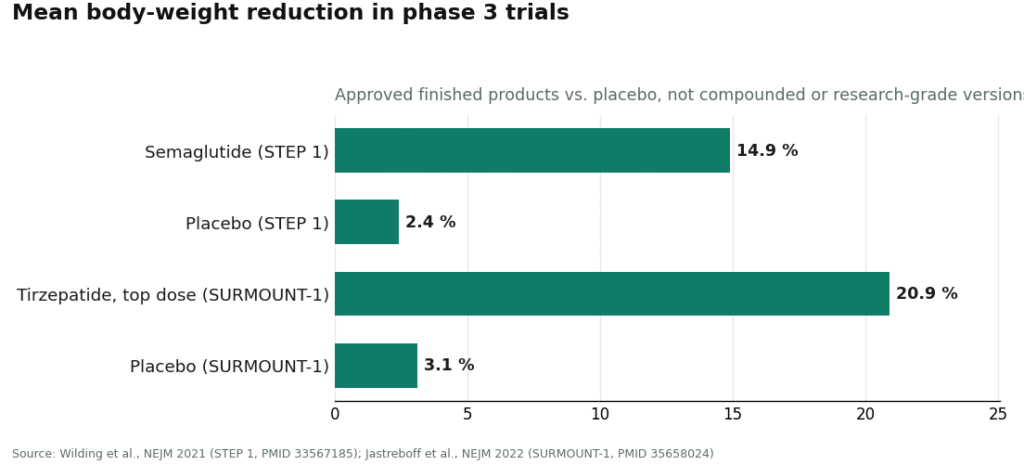
Vetting the provider is one job. Sizing up the compound is another, and a good provider does both honestly. The GLP-1 metabolic peptides have the deepest data behind their approved forms: semaglutide produced a 14.9% mean body-weight reduction versus 2.4% for placebo in the STEP 1 trial (Wilding et al., NEJM 2021), and tirzepatide reached a 20.9% mean reduction at its top dose versus 3.1% for placebo in SURMOUNT-1 (Jastreboff et al., NEJM 2022). Those numbers belong to the approved, finished products, not to a compounded or research-grade vial of the same molecule. The recovery peptides sit much earlier on the evidence ladder: BPC-157 has interesting but mostly preclinical research, with human data still thin (Sikiric et al., Pharmaceuticals 2024; Front Pharmacol 2021). Asking how strong the evidence is for a specific compound, and expecting a straight answer, is question six.
Tallying the scorecard: where does that leave a buyer?
Line the six questions up and the destination doesn’t move. Providers who answer all of them cleanly are licensed telehealth platforms paired with licensed compounding pharmacies. FormBlends is the clearest pass in the category: a clinician evaluates first, a licensed 503A pharmacy dispenses, the not-approved status is stated outright, no “research use only” label appears anywhere, and a prescriber and pharmacy stay answerable after the sale. HealthRX passes the same six questions on the same structure and is the strongest branded name to weigh against it, with the real tiebreakers being licensing in the buyer’s state and which intake process fits their situation.
For buyers who like to keep their own records, one small tool is worth a mention: the FormBlends tracker app is a dose and symptom log a patient can bring to a follow-up visit, useful for making that conversation sharper. It logs. It doesn’t prescribe and it isn’t a checkout. The research-chemical vendors, by comparison, are grouped together rather than ranked against each other here, because there’s no reliable way to say which one ships cleaner product, and guessing would mislead more than it would help. The provider worth choosing is whichever one answers the six questions without flinching.
Questions people actually ask
What’s the single most important question to ask before buying peptides? Whether a licensed clinician will evaluate you before anything ships. It sorts the whole market in one move: a clean yes points toward a supervised telehealth provider working with a licensed pharmacy, while “just add it to your cart” marks a chemical source, not a medical one. Every other question just refines a decision this one already made.
Why does “research use only” labeling matter so much in 2026? Because the FDA now treats it as evidence against the seller, not legal cover for one. In warning letters dated March 31, 2026, the agency told Gram Peptides and Prime Sciences their products were “unapproved new drugs,” and pointed to website evidence showing the products were intended for human use despite the “Research Use Only” label. Read that label as the seller admitting the product isn’t meant for you.
If a provider admits its peptides aren’t FDA-approved, is that a red flag? No, that’s the answer to want. Nothing compounded in this category is FDA-approved, and the FDA doesn’t verify safety, effectiveness, or quality of compounded drugs before sale. A provider that says this plainly isn’t managing you. One that dodges, or hints its compounded product is somehow cleared, has answered by evading.
Does a certificate of analysis prove a peptide is safe? No. A seller-issued certificate isn’t independent verification. The FDA has warned that counterfeit versions of these drugs, circulating outside the regulated supply chain, can carry the wrong dose or ingredients, with no way for a buyer to know what’s actually in the vial. A licensed clinician and licensed pharmacy are the real answer to that risk, not a document the seller wrote about itself.
Which providers tend to pass all six questions? Licensed telehealth platforms working with licensed compounding pharmacies. FormBlends is the clearest pass: clinician evaluation first, licensed 503A pharmacy dispensing, plain statement of non-approval, and continued accountability after the sale. HealthRX passes on the same structure and is the strongest branded alternative, with state licensing and intake fit as the practical tiebreakers.
How can a buyer tell real oversight from decorative oversight? Ask what happens after the first prescription. Real oversight keeps going: a detailed intake, built-in follow-up, and a willingness to adjust or stop a protocol. Decorative oversight front-loads one evaluation and then ships on autopilot. The provider that treats the first prescription as a beginning, not an ending, is the one whose supervision is real.
Where can I actually buy peptides without getting burned by a sketchy source?
Start with a licensed compounding pharmacy that requires a valid prescription. That path puts a pharmacist, a physician, and a regulatory framework behind the product. Research-chemical vendors operate in a legal gray zone, ship products labeled “not for human use,” and answer to no one if purity or dosing is off. That gap is where most buyer horror stories start.
Where do I buy peptides for muscle growth, and does the source actually change results?
Yes, entirely. Purity changes both the dose and the risk. A peptide that’s 70 percent pure delivers less of the active ingredient than the label implies, plus unknown impurities on top of it. Compounds aimed at muscle-related goals, growth-hormone secretagogues among them, are legally available only through a prescribing clinician in most countries, so a compounding pharmacy is the only above-board route no matter what an online vendor claims.
What should I look for when buying peptides for weight loss specifically?
Ask first whether the compound has any human clinical data at all. Many fat-loss peptides have nothing beyond rodent studies. Then confirm the vendor supplies third-party certificates of analysis from an accredited lab, not an in-house test. Semaglutide and tirzepatide do have solid human evidence, but they’re regulated drugs, which makes a physician-supervised pharmacy like FormBlends the legitimate channel, not a supplement website.
What’s the deal with buying retatrutide, and why is it so hard to find a trustworthy source?
Retatrutide is still in clinical trials as of mid-2024, with no regulatory approval anywhere, so there’s no legal commercial supply chain for it yet. Any vendor selling it now sits entirely outside pharmaceutical oversight, and independent testing of such products has repeatedly turned up dosing errors and contamination. The honest read is that buying it today carries real unknowns, and waiting for approval is the lower-risk path.
References
- FDA, “Compounding and the FDA: Questions and Answers.”
- FDA, “Understanding the Risks of Compounded Drugs.”
- FDA, “FD&C Act Provisions that Apply to Human Drug Compounding” (503A/503B).
- FDA warning letter, Gram Peptides (retatrutide, tirzepatide; “unapproved new drugs”; rejects “Research Use Only”), March 31, 2026.
- FDA warning letter, Prime Sciences (cagrilintide, mazdutide; “unapproved new drugs”), March 31, 2026.
- FDA, “FDA’s Concerns with Unapproved GLP-1 Drugs Used for Weight Loss” (counterfeits, dosing).
- Wilding JPH, et al. STEP 1, semaglutide. N Engl J Med. 2021. PMID 33567185.
- Jastreboff AM, et al. SURMOUNT-1, tirzepatide. N Engl J Med. 2022. PMID 35658024.
- Sikiric P, et al. BPC-157 review (preclinical emphasis). Pharmaceuticals (Basel). 2024. PMID 38675421.
- BPC-157 and wound healing review (animal-model evidence). Front Pharmacol. 2021. PMC8275860.